Feb 28, 2026
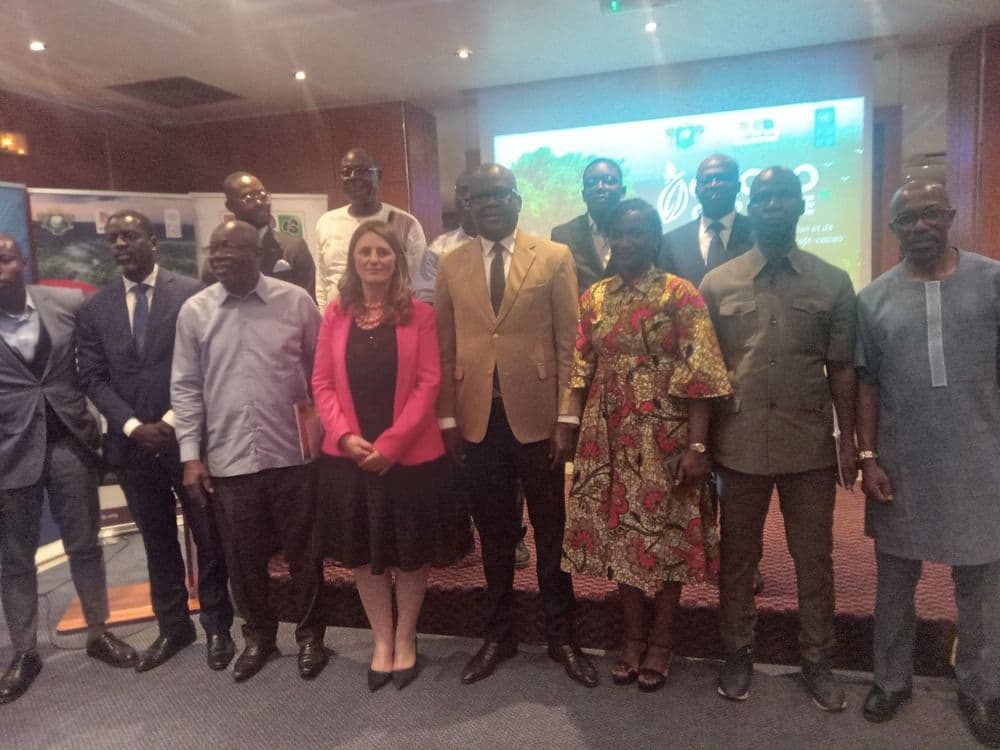
Côte d’Ivoire eyes 2.5m hectares of carbon-neutral cocoa in 2035
The Ivorian government and stakeholders in the coffee and cocoa sector launched the Cocoa Carbon+ Initiative an ambitious programme aimed at transforming cocoa orchards into agroforestry systems and generating over $1 billion in carbon revenue.
The challenge is immense for the world’s leading cocoa producer: Côte d’Ivoire has lost 80 per cent of its forest cover in six decades. Faced with this environmental emergency, which threatens the livelihoods of 5 million people, the Coffee and Cocoa Council is now establishing a unique governance framework for agroforestry.
Patricia Assamoi-Ouffoue, Deputy Director in charge of Research at the Coffee and Cocoa Council, unveiled the national ambitions: the conversion of 2.5 million hectares to resilient agroforestry systems by 2035. This project includes planting 100 million trees within cocoa and coffee plantations.
The stakes are not only environmental, but also financial. “The goal is to achieve $1.25 billion in long-term carbon revenues,” explained Assamoi-Ouffoue. This mechanism should diversify the income sources of 750,000 direct beneficiary producers, while guaranteeing “zero-deforestation” cocoa.
This first plenary assembly of the National Platform for the Coordination of Agroforestry Initiatives, held on February 25 and 26,2026, resulted in the definition of a strategy structured around four key components.
According to Patricia Assamoi-Ouffoué, the first component is harmonized governance involving all stakeholders, a sectoral framework to avoid the risk of fragmentation. The second concerns high-integrity carbon projects, which implies adherence to environmental and social standards.
The third component is inclusion and sharing, with the aim of ensuring that financial benefits actually reach producers, while the fourth component concerns strategic development, aiming to position Côte d’Ivoire as a leader in low-carbon cocoa.
The deployment of the Cocoa Carbon+ Initiative is expected to be gradual, beginning with an eight-month feasibility phase, followed by a pilot phase (6 to 36 months) in two or three representative areas before global scaling up.
Present at this meeting, Blerta Cela, UNDP representative in Côte d’Ivoire, welcomed this “milestone achieved,” which brings coherence to climate action.
She did, however, point out that gender mainstreaming and the local processing of cocoa residues remain areas for further exploration.
For Wahatami Coulibaly, representing the Director General of the Coffee and Cocoa Council, this initiative aims to “better coordinate agroforestry initiatives and carbon projects within the coffee and cocoa sector.”
“The launch of Cocoa Carbon+ is a major step in our collaboration; it reflects our commitment to structuring carbon valorization within the coffee and cocoa sector with a central objective: to generate tangiblebenefits for producers,” he said.
By institutionalizing carbon valorization at this first plenary assembly of the National Platform for the Coordination of Agroforestry Initiatives, the country hopes to ensure the sustainability of the cocoa sector, which represents 15% of GDP and 40% of national exports.