Apr 18, 2026
By Mahder Nesibu
The world's appetite for critical minerals has turned Africa into a theatre of intensifying geopolitical competition. For the continent, the question is whether this moment ends differently from previous resource booms.
In February 2025, the African Union formally adopted the African Green Minerals Strategy, a continental framework designed to reshape how Africa engages with one of the fastest-growing commodity markets in the world. The timing was deliberate. Demand for lithium, cobalt, graphite, and rare earth elements is rising at a pace that no previous resource cycle has matched. By 2040, the International Energy Agency projects the world will need five times as much lithium and more than twice as much cobalt as it produces today. Africa holds the majority of known reserves of several of these minerals. The continent is, once again, precisely what the world needs.
Critical minerals are the material foundation of the technologies reshaping the global economy. Beyond their role in electric vehicles and renewable energy grids, they underpin the semiconductors and fiber-optic systems on which artificial intelligence runs. Gallium and germanium, found in significant concentrations across central and southern Africa, are essential to high-speed AI chips. AI-specific demand alone is projected to increase germanium consumption by 37 percent and gallium consumption by 85 percent by 2033. Africa is not sitting on the past. It is sitting on the infrastructure of the future.
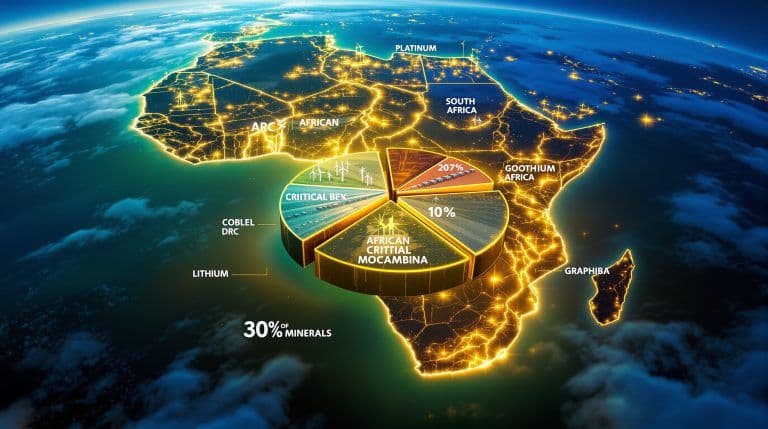
The continent holds approximately 30 percent of global mineral reserves: 55 percent of cobalt, 47 percent of manganese, and more than a fifth of known natural graphite. The DRC alone supplies over 70 percent of global cobalt output, and the United States State Department estimates its total mineral wealth at 24 trillion dollars. South Africa holds around 80 percent of known platinum group metal reserves. Zimbabwe, Mozambique, Madagascar, Angola, and Tanzania are each emerging as significant sources of lithium, graphite, or rare earths. The scale of Africa's endowment is now being measured against real and surging demand. And yet the DRC ranks among the five poorest nations on earth, with nearly three quarters of its population living below two dollars and fifteen cents a day. The disjunction between resource wealth and human welfare is not incidental. It is the central story of Africa's economic history, and it has a structure.
That structure was built over centuries. Colonial powers extracted minerals from Africa to build their own economies, not African ones. What independence brought, across most of the continent, was formal sovereignty over the same economic architecture: raw materials flowing outward, finished goods flowing inward, and the difference in value captured elsewhere. The structural adjustment program of the 1980s and 1990s reinforced this arrangement, dismantling the industrialization efforts that might have broken it. Africa entered the twenty-first century still overwhelmingly dependent on raw material exports, still generating most of its foreign exchange from the first stage of commodity chains it did not control.
Today, fewer than five percent of Africa's critical minerals are processed on the continent before export. African countries collect only around 40 percent of the revenue they could theoretically derive from their own mineral wealth. In 2023, the DRC's Finance Minister disclosed that the country was losing close to one billion dollars a year in cobalt and copper smuggled into Rwanda alone. In the mining zones of Katanga province, an estimated 40,000 children dig for cobalt earning less than two dollars a day. That cobalt ends up in batteries sold for hundreds of dollars in consumer markets across the Global North. Scholars have coined the term "green extractivism" to describe the risk that the clean energy transition reproduces this arrangement under new branding. The language changes. The structure does not.
What has changed is the intensity of outside interest. The United States, alarmed by China's dominance over critical mineral processing, invested in the Lobito Railway Corridor in 2024 and convened a multilateral minerals alliance in early 2025. The DRC has reportedly proposed a minerals-for-security arrangement to Washington, offering accelerated resource access in exchange for support against the armed insurgency in its eastern provinces. The European Union has signed strategic partnership agreements with Namibia, Zambia, and the DRC under its Critical Raw Materials Act, promising investment in local value chains as part of their terms. China, meanwhile, already controls the processing infrastructure that sits between African raw materials and global supply chains, accounting for 91 percent of global critical mineral refining. Africa can send its ore in any direction without changing the fundamental dynamic. The challenge is to build the capacity to transform it.
Nigerian statesman and Visiting Professor at King's College London, J. Kayode Fayemi, has framed what this moment demands with precision. Writing on Africa's relationship with Western technology powers, he argues for a genuine partnership: "Artificial intelligence, digital infrastructure, and the platform economy are already reshaping global productivity. Africa cannot be a passive consumer of technology built elsewhere and governed by rules written without us." The argument applies directly to the mineral foundations of that technology. If Africa's cobalt, germanium, and lithium are to be integrated into battery networks and AI hardware ecosystems, that integration must extend beyond the pit to include the refinery, the precursor facility, and eventually the manufacturing plant. Every stage of the value chain that leaves the continent is a stage of revenue, employment, and technological knowledge that does not return.
The AU's response has been to build a framework before the terms of the new resource relationship are fixed. The African Mineral Development Centre was established to support member states in capturing more of the value from their mineral wealth, with particular emphasis on green minerals and beneficiation, the processing of raw ore into refined and manufactured products before export. Several governments have moved unilaterally: Zimbabwe banned raw lithium exports to stimulate local processing, Burkina Faso mandated in-country beneficiation in its new mining code, and Namibia tied green hydrogen licensing to mineral processing incentives. The African Continental Free Trade Area, creating a unified market of 1.4 billion people, offers the infrastructure for regional value chains, allowing minerals from one African country to be processed in another while qualifying for preferential continental trade terms.
The limits of these policies are real. Lithium processing requires more than 50,000 liters of water per metric ton of output. Zimbabwe, prone to drought and carrying a significant power deficit, cannot currently comply with the requirements of its own export ban at scale. The AMDC has yet to be fully operationalized: only four of the fourteen member states required for ratification have done so. The AU strategy calls for whole-of-government coordination across minerals, energy, infrastructure, and trade simultaneously, in countries where the technical capacity in metallurgical engineering, mining economics, and trade law is severely constrained. These are not objections to the strategy. They are the distance between the ambition and its execution.
Botswana offers the clearest evidence that the distance can be closed. Its management of diamond revenues over several decades, through low corruption, enforced contract terms, and deliberate reinvestment in public institutions, produced the highest rate of economic transformation achieved from a single commodity anywhere on the continent. It did not eliminate extraction. It captured a far larger share of the value and used it with purpose. The lesson is not that extraction is benign. It is that state capacity and coherence determine what extraction produces.
Ethiopian Prime Minister Abiy Ahmed, speaking on the terms that should define Africa's relationship with Europe, described the aspiration: a partnership built "not based on dependency, but dignity; not on extraction, but shared prosperity." The minerals are there. The demand is locked in by the physics of electrification and the computational logic of artificial intelligence. Whether this boom ends differently from every previous one depends on whether African governments can now convert that geological advantage into the contract terms, fiscal regimes, processing mandates, and institutional investments that give the aspiration meaning. The window is open. It has been open before.