May 6, 2026
By Mahder Nesibu
The Adwa Victory Memorial sits in the Arada district at the centre of Addis Ababa, entered through one of eight gates, each bearing a name. The Pan-African Gate is among them. Before a visitor has stepped inside, before they have encountered a single artefact or read a single panel, that outside walls announce something about the nature of what happened at Adwa on March 1, 1896, and about who the victory belongs to. It was a declaration that the battle fought in the highlands of northern Ethiopia was larger than Ethiopia, that it reverberated outward, and that its meaning was shared across a continent and a diaspora.
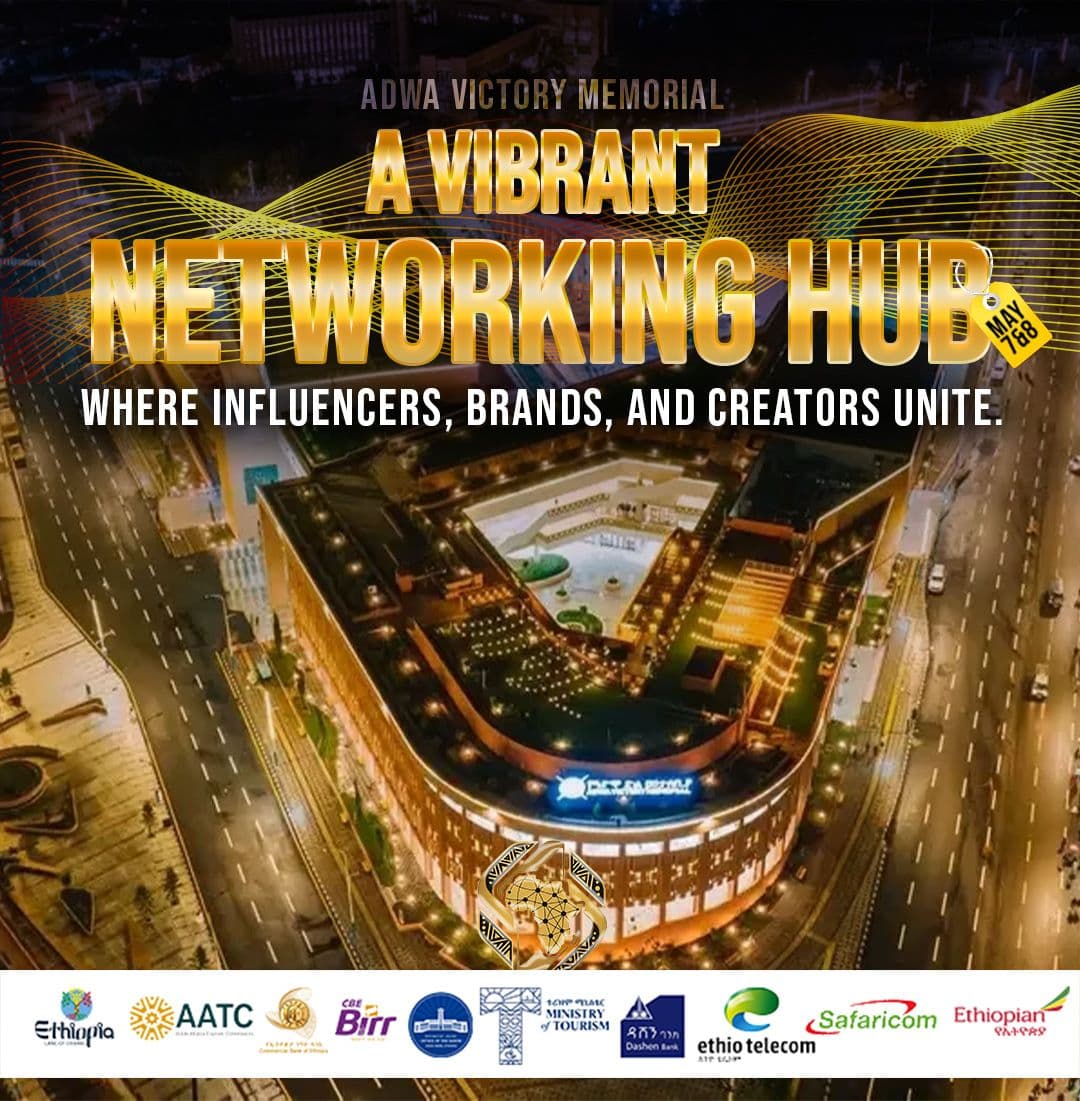
On May 7 and 8, Africa's leading digital creators, media practitioners, and policymakers will gather at this memorial for the African Social Media Influencers Summit.
The colonial project in Africa rested on more than military force and economic extraction. It required a justification, an account of why European rule over African peoples was moral and legitimate. That account held that Africans were incapable of self-governance, that their civilizations were primitive, that their subjugation was the cost of progress. Ghanian diplomat Thomas Kwesi Quartey identified precisely this when he observed that the Ethiopian victory at Adwa dismantled the theoretical rationale that colonial policy used to legitimize the supposed inferiority of Africans, which had served as the cornerstone justifying the practice of racism and colonial rule. Adwa did not merely defeat an Italian army. It refuted a story.
That refutation had consequences well beyond the battlefield. When news of the Ethiopian victory reached black intellectuals across the diaspora, the response was not simply one of celebration but of intellectual reckoning. The story that had been told about Africa, the story that underwrote slavery, colonial conquest, and every system of racial subjugation, had been challenged by an African army on an African battlefield. What had been presented as inevitable was revealed as a choice that could be resisted and reversed. The thinkers who drew on Adwa in the years that followed —the figures behind the Pan-African Congress of 1900 —were engaging in precisely this kind of counter-narration. They were building an alternative account of what Africa was and what it was capable of, grounded in the evidence that Adwa had produced.
The intellectual movement that Adwa energized found its organizing form in the Pan-African Congress. Ethiopia was represented at that congress by an official delegate of Emperor Menelik II, a signal that the convergence between African independence and diaspora consciousness was recognized on both sides. The Ethiopianism movement, which preceded and fed into Pan-Africanism, had already made Ethiopia central to the self-perception of black intellectualism. Adwa deepened that centrality by making Ethiopia a living proof of a different possibility.
This current of thought ran through the decades that followed, through the fascist invasion of 1936, which itself produced a new wave of solidarity and a sharpened sense of what was at stake, through the independence movements of the mid-20th century, and eventually to Addis Ababa, where the Organization of African Unity was founded in 1963. Ghana’s first President Kwame Nkrumah, who co-founded the OAU and whose thinking had been shaped by the same intellectual inheritance, understood the relationship between narrative and liberation with clarity. Speaking to African journalists that same year, he stated that the role of the African journalist was to serve as a collective organizer, a collective instrument of mobilization, and a collective educator. The work of telling Africa's story, in his framing, was political work.
The Adwa Victory Memorial encodes this understanding in its architecture and curation. The statues of Emperor Menelik II and Empress Tayitu Betul anchor the open compound, their scale reflecting their centrality to the campaign. The commanders affixed as pillars of the main structure, figures like Ras Mekonnen and Dejazmach Balcha Safo, represent the diverse regions of Ethiopia that converged on Adwa in a unified effort. A room within the memorial carries pillars inscribed in Ge'ez with words translating as "Victory," "Sacrifice," "Patriotism," and "Black Peoples' Victory." That last inscription is significant. It does not say "Ethiopian Victory." It reaches for a wider claim, the same claim the Pan-African Gate makes at the entrance.
The wall titled "From Adwa to the African Union" makes the argument most explicitly. It traces a visual timeline from the 1896 battle to the formation of the African Union in 2002, treating the arc from battlefield victory to continental institution as a coherent progression. Nkrumah and Marcus Garvey appear on this wall as inheritors and amplifiers of what Adwa set in motion. The wall ends in 2002. It presents that endpoint as a destination reached, which it was. But a destination reached is also a platform from which the next journey begins. The summit gathering within these walls in May suggests that the wall has further entries to accommodate.
The significance of the host city extends beyond the memorial itself. Addis Ababa is the seat of the African Union, the diplomatic capital of the continent, and a city in the process of physical and institutional transformation. The urban corridors reshaping its landscape are expressions of ambition that runs parallel to the political and cultural ambitions the city has long carried. As the city that became home to the OAU precisely because of Ethiopia's place in the Pan-African imagination, and as the city that now hosts the AU's institutions, Addis Ababa carries a particular weight for any gathering that concerns itself with the direction of African affairs. Convening a continental conversation about narrative and digital sovereignty here is a choice that reflects that weight.
ASMIS 2026, and Its Parallel to That Proud History
The African Social Media Influencers Summit arrives at a specific moment. Africa's internet user base has grown from roughly 181 million in 2014 to 646 million by 2024, with projections suggesting 1.1 billion users by 2029. Seventy percent of sub-Saharan Africa's population is under thirty. For this generation, social media has become the primary source of information, and for the first time, African voices can reach continental and global audiences without passing through any external editorial gate. The structural condition that made it possible for external narratives to define Africa, namely that Africans lacked the platforms and the reach to contest those narratives at scale, has begun to shift.
Yet reach alone does not constitute narrative sovereignty. ASMIS, organized by the Pulse of Africa in collaboration with AGA-Tech Enterprise, is built on the recognition that converting individual reach into sustained continental force requires organization, shared infrastructure, and institutional ambition. Its agenda covers digital innovation, artificial intelligence in content creation, and the construction of commercial partnerships between African creators and enterprises. Its stated vision is a globally connected Africa where African digital voices lead the global conversation. The Pulse of Africa, whose mandate at its October launch was described by Ethiopia's Prime Minister Abiy Ahmed as countering negative media representations of Africa and asserting African agency in shaping African narratives, is the organizing intelligence behind the summit.
The negative narratives that ASMIS exists to challenge have a long history. The framing of Africa as a continent of crisis, the editorial choices of international wire services and broadcasters that filtered African life through the lens of famine, conflict, and instability, these were not neutral representations. They were accounts produced from the outside, accounts that served particular purposes and carried particular consequences, diplomatic, economic, and psychological. The Nigerian writer Chinua Achebe captured the structural problem with precision: "Until the lions have their own historians, the history of the hunt will always glorify the hunter." The hunters in this formulation have had a long lead. What has changed is the emergence of tools and platforms that make it possible for the lions to produce their own account, at scale, in real time, and without permission.
The Pan-African Gate of the Adwa Victory Memorial did not acquire its name by accident. The people who designed and built the memorial understood that what happened at Adwa in 1896 was claimed by more than Ethiopians, that it entered the consciousness of African and diaspora communities as evidence of a possibility they were already reaching toward. The summit that will gather inside those gates in May is reaching toward the same possibility by different means. The medium has changed. The battlefield is digital. The questions are who controls the account of African life, who frames it, who distributes it, and whose purposes it serves.