Red Sea Security Is a Shared Interest
Oct 7, 2026
Save
By Staff Writer
Shipping lanes carry the energy, food, raw materials and components that keep economies running, and UNCTAD puts the share of world trade by volume that moves by sea above 80 percent. Disruption travels along trade networks, which extend well beyond any coastline. The Red Sea concentrates that exposure. It joins the Indian Ocean to the Mediterranean through the Bab el-Mandeb and the Suez Canal, and the IMF estimates that about 15 percent of global maritime trade volume normally passed through Suez before late 2023. A route of that weight serves far more states than the ones on its shore.
Recommended News
Zambia, Angola, DRC Push Lobito Corridor Development
The past three years show chokepoints becoming instruments in wars fought elsewhere. The Houthis began attacking commercial vessels in late 2023 in connection with the war in Gaza, and by the IMF's measure Suez Canal trade volume fell by half year on year in early 2024 as carriers diverted around the Cape of Good Hope. In 2026 the war with Iran effectively closed the Strait of Hormuz and cut off some 20 million barrels of oil and refined products a day, a fifth of global consumption. Each episode followed the same sequence. A conflict with its own causes reached a shipping lane, and the lane's users, who had no stake in the dispute, absorbed the cost.
The Red Sea has now entered a more serious phase. Hormuz had already turned the sea into a bypass, with Saudi Arabia redirecting oil exports to Yanbu on its Red Sea coast. In September the Houthis, who had resumed hostilities with Saudi Arabia in July, took Mokha and Perim Island and brought the whole of Yemen's west coast under their control, according to Security Council Report. The movement now holds ground inside the strait, so its leverage rests on position as well as on missiles and drones. Media reports place Iranian Revolutionary Guard advisers in the offensive, and Washington frames events in Yemen within its confrontation with Tehran. The Bab el-Mandeb is now linked to the Gulf war that closed Hormuz.
Capability has grown alongside position. The UN sanctions panel is reported to have found that more weapons are now produced inside Yemen and that the arms embargo no longer stops the flow of materiel. A threat that is produced locally and costs little to sustain can pressure a route worth far more than the weapons used against it.
The costs fall unevenly. Firms with thin inventories, small importers and governments that depend on import duties feel disruption first, while large firms absorb or pass on higher freight and insurance. The heads of the IEA, the IMF and the World Bank called the 2026 shock "substantial, global, and highly asymmetric", with energy-importing low-income countries hit hardest. A route secured only for those who control its shores leaves these users exposed with no voice in how it is protected.
Protection has come largely from outside the coastal states. Contacts with the Houthis have run through Oman, which has no Red Sea coastline, and Security Council Report records US officials meeting the group there in September, where it said it would confine attacks on commercial shipping to Saudi vessels. France and Britain are helping Saudi Arabia defend its Red Sea energy sites. Saudi Arabia is a littoral state, and its own defence rests on non-littoral partners. Carriers meanwhile pass a coastline whose controllers set the terms of passage.
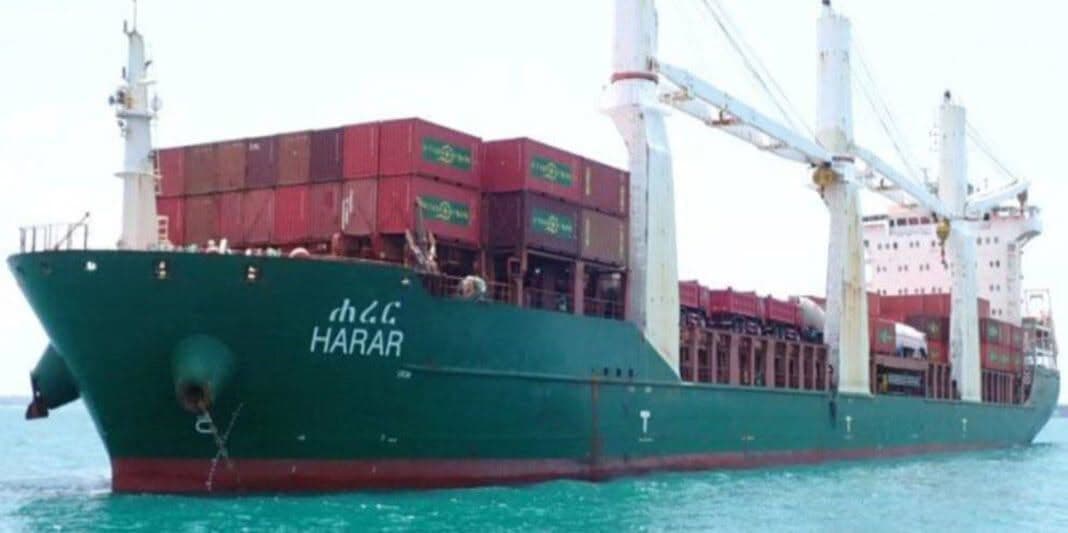
Ethiopia sits inside this system. It has no coastline, and the World Bank reported in 2023 that more than 95 percent of its import-export trade by volume used the Addis-Djibouti corridor, which ends at the Gulf of Aden and the Bab el-Mandeb. Djibouti's port economy rests on that cargo, and the fighting across the strait has already sent refugees to its camps. Egypt's Suez Canal revenues rise and fall with traffic on the same route. Each state pays a different price for disruption, and none can insulate itself from the consequences.
Cairo and Asmara answer this exposure with a doctrine. In May 2026 their foreign ministers declared Red Sea security the "exclusive responsibility" of littoral states and rejected any role for non-littoral parties, a position regional reporting read as aimed at Ethiopia's pursuit of sea access. The doctrine assumes that coastal status brings the capacity to secure the route. The record shows otherwise. The force holding the western shore of the strait is itself a coastal power and the main threat to shipping, and the coastal state most exposed to it is looking abroad for defence. The declaration as reported sets out no mechanism for securing the strait.
A workable policy starts from what can be delivered. That means protection of civilian shipping, timely sharing of information on hazards, coordinated search and rescue, and open channels for crisis communication, including channels to the Houthis, whose position gives them the means to stop traffic. Narrowing the agenda this way keeps the protection of navigation apart from the wider contests, as far as circumstances allow. Security and politics cannot be separated completely, but a shared minimum gives each party a reason to keep ships moving. Participation should follow exposure and capability. Saudi Arabia, Djibouti, Ethiopia, Egypt, the external navies and the mediators each hold part of what the route requires, and any arrangement has to account for an armed movement on the coast and a regional war behind it.
The cost of exclusivity falls on the importer and the household, on Djibouti's port economy, on Ethiopia's single trade corridor and on the Suez Canal revenues that Cairo draws from steady traffic. Excluding the states with the exposure and the powers with the means leaves the route to whoever holds the shore. A durable Red Sea policy begins from the shared interest in keeping the passage open and builds practical cooperation around it.