Russia-Africa Summit 2026: What’s at Stake for Africa?
Oct 27, 2026
Save
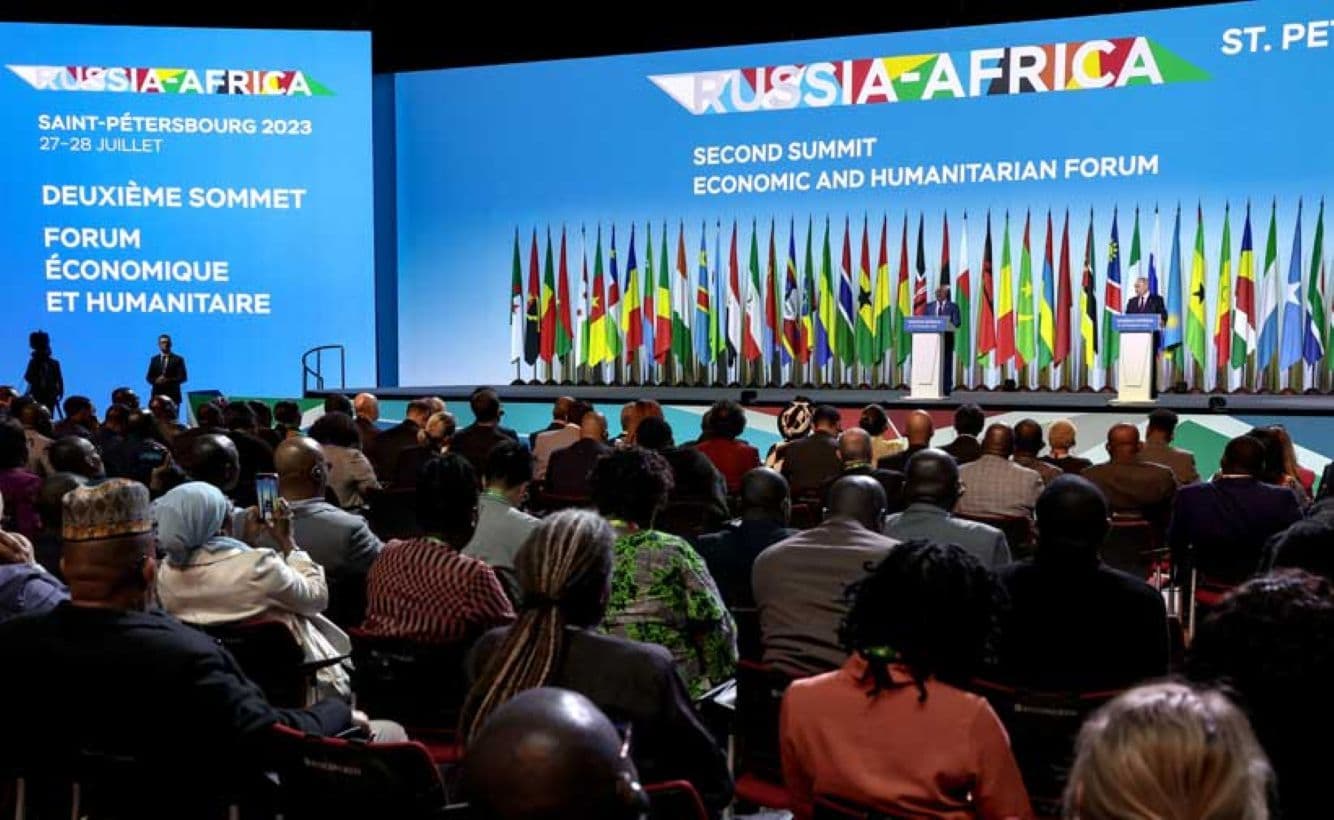
As African leaders gather in Moscow for the third Russia-Africa Summit on October 28–29, the key question is how the partnership can deliver tangible benefits for the continent. For Africa, the summit presents an opportunity to attract investment, expand access to markets, strengthen food and energy security, accelerate technology transfer, and advance industrialization by adding value to its own resources. It also offers a platform to diversify international partnerships, reinforce strategic autonomy, and promote Africa’s voice in global decision-making. The real measure of success, however, will be whether dialogue and agreements translate into balanced trade, local production, job creation, skills development, and sustainable prosperity for African countries.
Trade, sovereignty and peace are on the table in Moscow this week for the third Russia-Africa Summit. The meeting will set cooperation priorities for the next three years, alongside an Economic and Humanitarian Forum bringing together officials, businesses and experts. Russian President Vladimir Putin and Burundian President Evariste Ndayishimiye, the current African Union (AU) chairman, will co-chair the leaders’ plenary session on the second day.
Recommended News
Ethiopia’s Su-35 Acquisition Draws Regional Attention
The gathering follows summits in Sochi in 2019 and St. Petersburg in 2023.
Russia has invited all African heads of state and the leaders of regional organizations. Most African delegations have confirmed their participation, according to Russian Foreign Ministry spokeswoman Maria Zakharova.
What is on the agenda?
The topic of sovereignty is central to the forum, which features sessions on development financing, food security, and technological independence.
Discussions will cover infrastructure, transport corridors, industrial cooperation, and payment mechanisms that reduce reliance on the dollar and euro. Participants will also assess closer links with BRICS and the Eurasian Economic Union, including barriers that continue to restrict trade.
Interdependence regarding agriculture is a foundational sector for Russia-Africa relations, and the forum is expected to address fertilizer supplies, farm machinery, local production, and the financial and logistical obstacles facing food trade.
Peaceful nuclear energy is another priority. Rosatom has signed roadmaps to advance planned nuclear power projects in Ethiopia and Rwanda. Its cooperation with Rwanda also includes a proposed nuclear science and technology center for research, specialist training, and applications in medicine, agriculture, and industry.
Digital infrastructure discussions come as Africa’s online economy expands. GSMA’s 2025 assessment put the continent’s mobile internet users at 416 million, projected to reach 576 million by 2030. African companies also bring established financial technology expertise: Kenya’s Safaricom said its M-PESA mobile money service reached 40 million customers in March 2026.Other sessions cover artificial intelligence, healthcare and training African specialists.
Why is the summit important?
African priorities include processing more resources at home, building energy and technological capacity, and diversifying partnerships on their own terms.
The summit builds on sustained diplomatic engagement. Since 2022, Lavrov has visited countries across the continent, including repeated trips to Egypt, Ethiopia and South Africa. His July 2026 tour included Ethiopia, Niger, Mozambique, and Burundi.
The summit framework has also developed into regular ministerial consultations. Sochi hosted the first ministerial conference of the Russia-Africa Partnership Forum in November 2024, followed by a second in Cairo in December 2025.
The gathering for Russia “is a momentous event – hardly ever before have so many leaders gathered together in the Kremlin,” Andrey Maslov, director of HSE University’s Center for African Studies, told RT on Monday. He described relations as undergoing a slow but sustained strengthening, supported by an expanding network of intergovernmental commissions, business councils, and other institutions.
Trade between Russia and Africa rose from $16.8 billion in 2019 to $27.1 billion in 2025, according to Nikolay Golovko, a leading expert at HSE’s Center for African Studies. The balance remains heavily tilted toward Russian exports, which accounted for $22.7 billion, compared with $4.4 billion in imports from Africa.
Russia and the AU also reiterated support in July for greater African representation in the UN Security Council, reflecting their push to reform global institutions.
What was the central theme of Summit
The inaugural summit took place in Sochi on October 23-24, 2019 under the motto “For Peace, Security and Development,” it established a framework for cooperation across politics, security, trade, science, education, and culture.
The event provided a foundation for 92 agreements, contracts and signed memorandums of understanding between participants, with publicly disclosed values totaling more than 1 trillion rubles, approximately $12.5 billion at the time. These were signed commitments rather than a measure of completed investment.
What did the second summit deliver?
The second gathering, held in St. Petersburg on July 27-28, 2023, expanded the format to include a humanitarian forum. Official delegations from 48 African countries attended.
Participants adopted a joint declaration and a cooperation action plan for 2023–2026. Separate declarations addressed counterterrorism, international information security and preventing an arms race in outer space. Organizers recorded 161 publicly disclosed agreements, many covering education, science, and other humanitarian cooperation.
What can we expect from 3rd Summit
A central expected outcome is a new Russia-Africa action plan for 2027-2029, replacing the framework adopted in St. Petersburg. Lavrov has said it will be approved at the Moscow gathering.
Zakharova has also said a substantial package of intergovernmental agreements and commercial contracts is expected. Putin will hold bilateral meetings, while Lavrov will host a working breakfast for African foreign ministers on October 28.
The gathering will also provide an opportunity to review implementation of the 2023-2026 action plan, Golovko writes. Its 181 points cover areas ranging from politics and security to agriculture, energy, transport, education, and investment.