Are Three Superpowers Rewriting Global Playbook in Shenzhen as Geopolitics Eclipses Pacific Trade?
Nov 19, 2026
Save
By Addis Getachew
In the southern Chinese tech hub of Shenzhen, the choreography began long before any policy was debated. On Wednesday evening, under the bright lights of the APEC welcome banquet, U.S. President Donald Trump stepped out from a tight cluster of black-clad photographers and security personnel. Moments earlier, he had walked a tarmac red carpet lined with cheering crowds, flowers, and an honor guard, exchanging a rare, lingering embrace with his host, Chinese President Xi Jinping, as military jets roared overhead.
Recommended News
Inside Ethiopia’s High-Stakes Push to Join the WTO
Few expected Xi to throw such a glitzy reception to Trump at a time when his party the GOP lost significantly to the Democratic rivals in midterms, giving the Democrats clean sweeps both in Congress and Senate.
Inside the banquet hall, the visual optics were just as pointed. Trump took his seat at the center of the main table with his back to the press corps, leaning in to speak with Xi on his left through interpreters. Just a few places down, Russian President Vladimir Putin—who had arrived earlier without a tarmac greeting from Xi—lifted a glass of red wine to join a toast led by the Chinese leader from a flower-adorned podium.
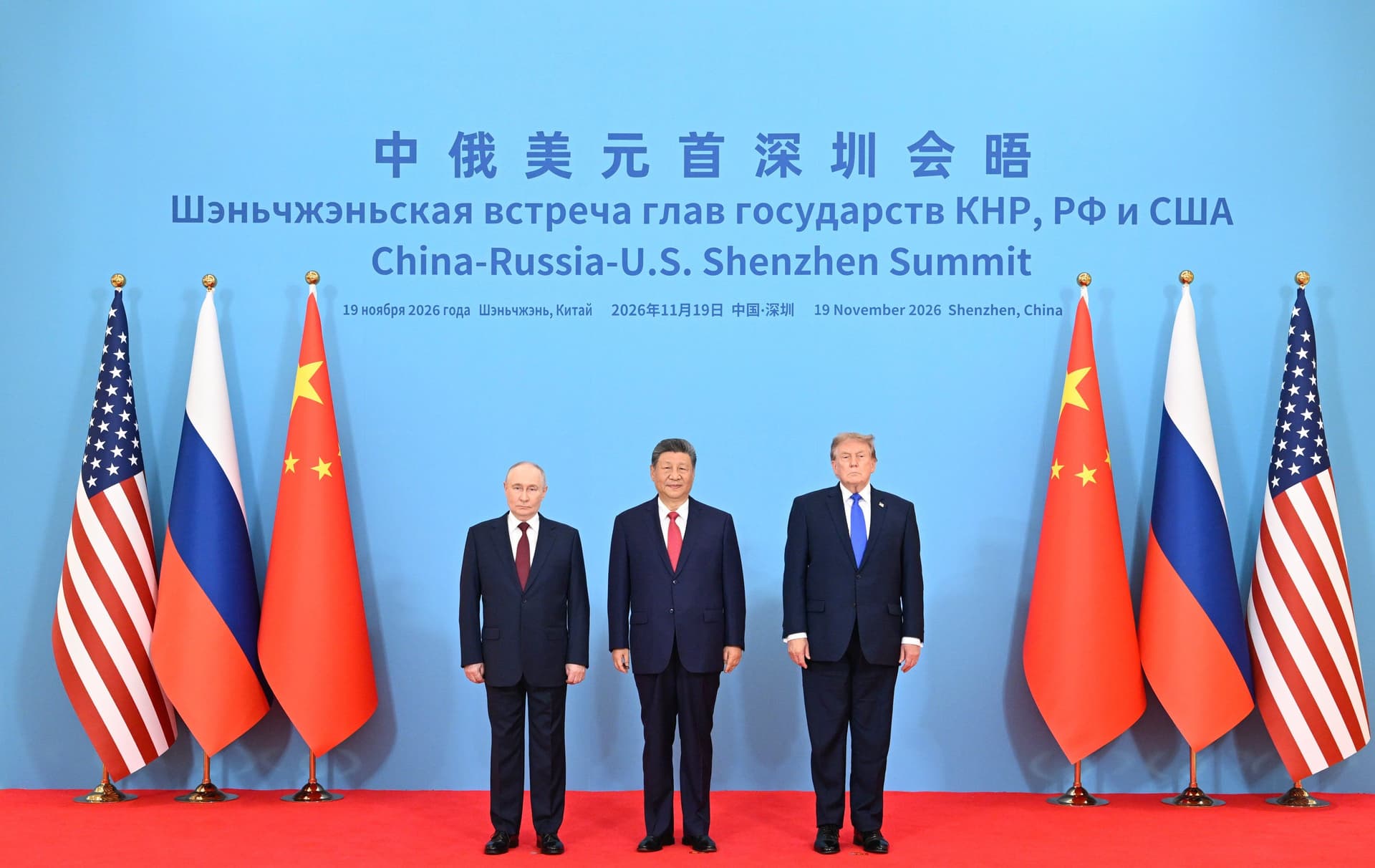
Before the doors closed to reporters, the three men stood together for the cameras, offering warm smiles and firm handshakes that masked the immense geopolitical friction between them. For a brief, carefully staged moment in Guangdong province, the commanders of the world’s three largest nuclear arsenals projected effortless camaraderie—setting a theatrical prelude for their unprecedented closed-door talks the following day.
The 33rd Asia-Pacific Economic Cooperation (APEC) Leaders’ Meeting in Shenzhen was designed to showcase regional trade and economic integration. Instead, the gathering of 21 Pacific Rim economies has been eclipsed by a historic geopolitical milestone, marking the first-ever formal trilateral summit between U.S. President Donald Trump, Chinese President Xi Jinping, and Russian President Vladimir Putin. While APEC delegates worked to advance consensus-driven trade goals, the meeting of the world’s three largest nuclear powers at Shenzhen’s Kylin Villa shifted the global spotlight to nuclear security, ongoing wars, and the race for artificial intelligence supremacy.
Ahead of their joint session on November 19, Trump held separate bilateral talks with Putin lasting roughly 40 minutes and with Xi lasting about an hour. According to diplomatic briefings and reports from CNN and Al Jazeera, the discussions center on four high-stakes issues. Following the expiration of the New START treaty in February 2026, no legally binding caps remain on U.S. and Russian nuclear arsenals, prompting Trump to push for three-way disarmament talks even though Beijing has historically resisted trilateral limits due to its smaller stockpile.
Meanwhile, the war in Ukraine dominated Trump’s one-on-one session with Putin and remains a central focus of the trilateral talks as Washington presses for a settlement. The leaders are also addressing ongoing U.S. military action and friction involving Iran, a nation with deep economic and military ties to both Moscow and Beijing. In his bilateral meeting with Xi, Trump further aimed to extend a fragile U.S.–China trade truce set to expire in January while working to secure vital rare earth mineral shipments.
Foreign policy analysts at the Brookings Institution and the BBC note that even if immediate policy breakthroughs remain elusive, the optics and power dynamics of the summit carry profound weight. Observers have compared the three-way sit-down to the 1945 Yalta Conference, noting that for Trump, the format reinforces a worldview anchored in direct, personal diplomacy among major powers. After years of Western isolation following the 2022 invasion of Ukraine, Putin’s prominent placement alongside Trump and Xi signals a major diplomatic victory and rehabilitation for Moscow. At the same time, by hosting the summit in Shenzhen and greeting Trump on the tarmac, Xi projects China as an indispensable superpower equal to Washington and Moscow, in the views of Western-oriented analysts. However, warm personal exchanges—including Trump calling Putin "my friend" and Xi referring to him as an "old friend"—have unsettled traditional U.S. allies in Europe and the Indo-Pacific, particularly Ukraine and Taiwan, who fear their interests could be sidelined.
Global technology and artificial intelligence risks have also emerged as a critical intersection between security and trade, playing out across both the trilateral and U.S.–China bilateral tracks, according to international media reports.
Diplomatic coverage from Al Jazeera and the Nuclear Threat Initiative (NTI) indicates that security experts are pressing the three powers to maintain "meaningful human control" over nuclear command systems and establish channels to manage AI, cyber, and space threats. Addressing the APEC plenary session, Trump warned of the risks of "super intelligence" but declared that Washington opposes any "globalist regulation" that might slow American innovation. Conversely, Xi used his speeches to champion multilateral AI governance and shared global standards, a stance critics note also serves to counter U.S. tech restrictions.
Bilateral U.S.–China talks remain tense over tightened U.S. export controls blocking Chinese access to top-tier AI semiconductors, unfolding in the wake of a major scandal at Nvidia where former CEO Jensen Huang recently resigned after admitting to an affair with an alleged Chinese intelligence agent. Despite this intense rivalry, Brookings notes that Washington and Beijing are working to establish a formal bilateral AI dialogue and a crisis-reporting channel for severe AI or biosecurity incidents.
Recall that last week, Microsoft suffered a major global outage affecting Microsoft 365 services from Thursday, November 12 through the morning of Saturday, November 14, 2026. The disruption knocked out Outlook, Exchange Online, Teams, SharePoint, and Copilot for millions of users across at least 74 countries. Airlines, healthcare systems, businesses and schools, cybersecurity tools were severely impacted, among others.
Beneath the shadow of great-power diplomacy, the formal APEC conference—operating under the theme "Building an Asia-Pacific Community to Prosper Together" and guided by its long-term Putrajaya Vision 2040—anchored its outcome documents and the business-led Shenzhen Initiative around core economic promises. Member economies reaffirmed non-binding commitments toward a Free Trade Area of the Asia-Pacific (FTAAP), lowering trade barriers, and endorsing an APEC roadmap on services. Leaders also focused on harmonizing cross-border data rules, mutually recognizing electronic trade documents, and expanding developing economies' access to AI benefits. To keep regional supply chains unimpeded, members pledged upgrades to smart customs, multimodal transport, cross-border payment systems, and smart tourism, alongside commitments to food system resilience, sustainable forest governance, low-carbon transitions, and digital entrepreneurship for women.
Ultimately, the 2026 Shenzhen summit highlights a stark divide in global affairs. While APEC’s 21 member economies continue to build consensus around seamless trade, digital standards, and green supply chains, the historic convergence of Trump, Xi, and Putin demonstrates that the future of global security, trade stability, and artificial intelligence rests heavily on direct—and deeply unpredictable—negotiations among the world's top superpowers.