Smart Tools, Stronger Roots: AI for African Health and Farms
Nov 25, 2026
Save
By Mesai M.
In Busia County, Kenya, cassava farmer Josephine Arisat used to pull up rotten tubers from plants whose leaves looked perfectly healthy to the naked eye. For years, silent viral infections kept her harvests down to half a kilogram per plant. Then a field officer showed her how to hover a smartphone running an offline AI app called Nuru over the leaves. Within seconds—and without an internet connection—the software spotted cassava mosaic and brown streak diseases early enough for her to salvage healthy cuttings and multiply her yields. (Anecdote taken from PlantVillage blog, March 23, 2020)
Recommended News
PM Abiy Ahmed Defends Rebasing Drive as Reflective of Fundamental Change in Economy
Kagame Urges Youth to Drive Continent's Future at 8th YouthConnekt Africa Summit
PM Abiy to Address Parliament on Government Performance and National Priorities
Ethiopia’s Sea Access Quest Strategic Imperative Red Sea Region Cannot Ignore: Former Minister
Ethiopia Vows Direct Role in Shaping Red Sea Security Architecture, Maritime Governance
Stories like Arisat’s capture why artificial intelligence carries a distinct promise in Africa. Rather than mainly cutting labor costs as in wealthier economies, it can help scarce resources reach more people. Clinics across the continent face specialist shortages, supply-chain gaps, and slow disease tracking, while farmers contend with low yields, food losses, and erratic weather. Well-designed AI can extend vital care and farming support to communities that have long been underserved.
The Fourth Industrial Revolution is reshaping how societies produce goods, deliver services, and manage public resources. Powered by AI, big data, connected devices, robotics, and blockchain, it replaces rigid, manual workflows with adaptable systems. For African nations, this shift is both an urgent challenge and a chance to accelerate development.
The economic upside is substantial, though projections vary. PwC estimates AI could add up to $15.7 trillion to the global economy by 2030, while Microsoft Africa has projected $1.2 trillion—a 5.6 percent GDP boost—across Africa by 2030. Private investment in African agritech also surged from roughly $10 million in 2014 to a peak of around $600 million in 2022 before facing tighter global venture markets.
Capital alone will not deliver broad gains. African countries must move past isolated commercial pilots and weave intelligent technologies into public systems. Aligned with national priorities, AI can narrow infrastructure gaps, strengthen essential services, and build homegrown technological capacity.
Reimagining African Public Health
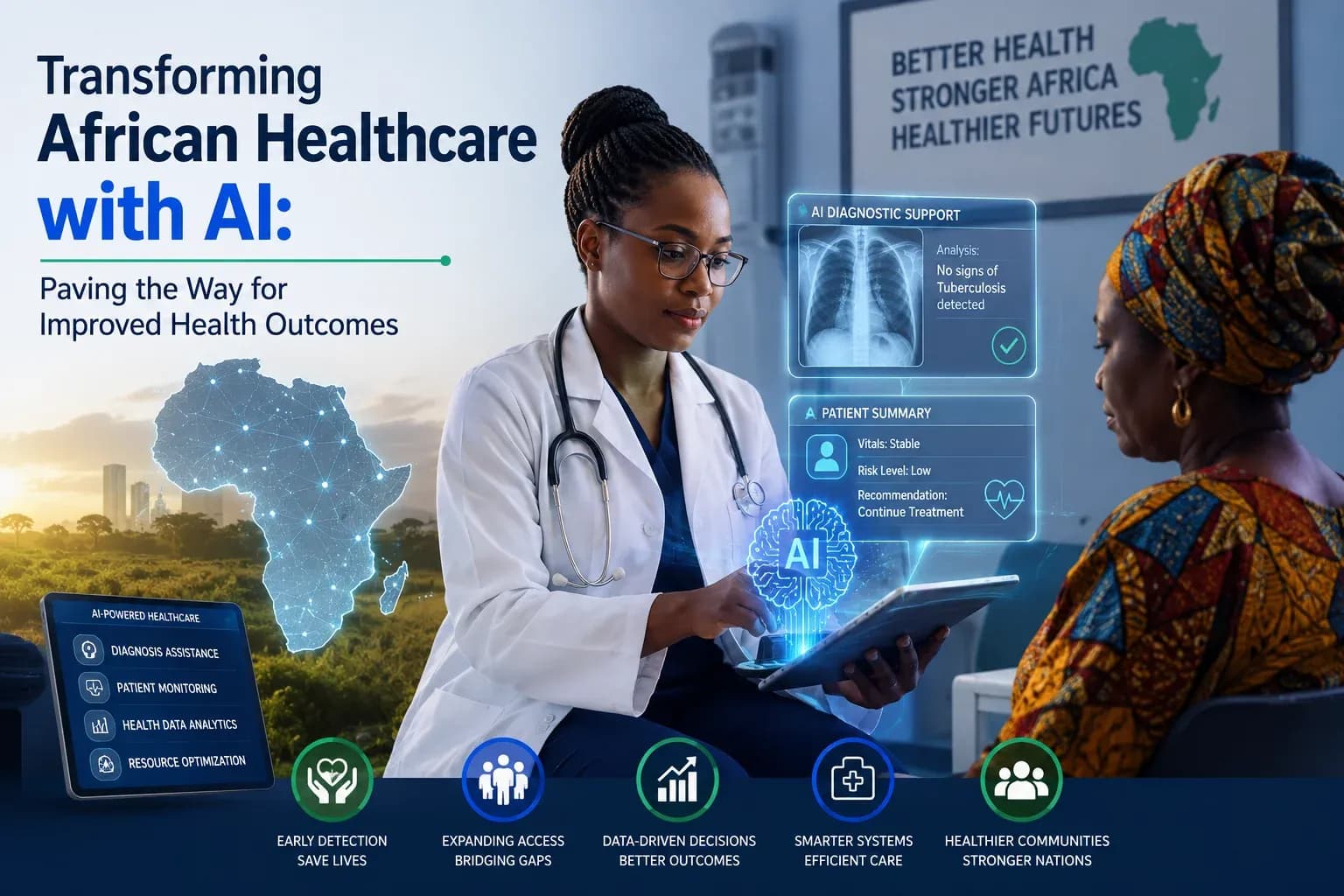
Across Sub-Saharan Africa, health AI is shaped by lean budgets and staffing shortages. Instead of relying on costly specialist hospitals, practical tools bring diagnosis closer to home, detect outbreaks faster, and stretch medical supplies. In Tanzania and Zambia, CAD4TB reads chest X-rays to screen for tuberculosis where radiologists are scarce. In Nigeria, Ubenwa analyzes infant cries to flag birth asphyxia, while trials in Zambia use machine learning to detect diabetic eye disease before vision loss becomes irreversible.
Africa’s role extends beyond frontline care. Germany’s BioNTech acquired Tunisian-founded AI firm InstaDeep in a deal valued at roughly €500 million (about $550 million), underscoring the continent’s growing strength in computational biology, vaccine design, and drug discovery. At the community level, combining lab results with climate and mobility data helps flag early disease outbreaks. Natural language tools parse clinical notes and verbal autopsies where death records are sparse, while predictive models prevent medicine stockouts and translation tools deliver emergency guidance in local languages.
Ethiopia is building the domestic expertise and infrastructure needed to sustain this progress. The Ethiopian Artificial Intelligence Institute (EAII) is advancing local skills in AI, robotics, and language technology. Digital networks now link more than 60 major primary hospitals, backed by a public health emergency system launched in 2026 to speed up crisis detection and coordination. That same year, EAII and WHO Ethiopia began building a strategic partnership to align local innovations—from skin-disease diagnostics to clinical translation tools—with national health priorities.
Smarter Farms, Stronger Harvests
Agriculture is the backbone of Sub-Saharan Africa, supporting more than 60 percent of its people, yet degraded soils, pests, low yields, and weak market links threaten food security. Across the continent, innovators are adapting AI to smallholders' realities. Following early breakthroughs with apps like Nuru, which has been piloted with roughly 28,000 Kenyan farmers, AI is now also assessing Fall Armyworm damage for agricultural insurance, while Hello Tractor connects smallholders with tractor owners, digitizing millions of acres and supporting rural jobs.
Timely advice is equally vital. Kenya’s Agricultural Observatory Platform delivers weather and planting guidance to 1.1 million farmers and is expanding toward West Africa. Offline plant-diagnosis apps in Cameroon, soil-testing kits in Ghana, and digital buyer platforms in Tanzania are also helping farmers make informed decisions and reach buyers.
Ethiopia’s Digital Agriculture Roadmap, 2025–2032
Ethiopia’s roadmap aims to modernize farming through 22 priority use cases and 32 enabling initiatives, covering everything from farm advisory and digital finance to input delivery and logistics. More than 10 million farmers are already connected to the country’s digital agriculture ecosystem, with a long-term goal of reaching 20 million smallholders with AI-enabled services.
At a 2026 workshop, government, research, and philanthropic partners examined how to accelerate adoption. Economic projections suggest that AI tools—such as crop and livestock diagnostics, climate forecasts, and tailored advice—could generate up to $3.5 billion in additional annual rural income over the next decade if 20 million farmers adopt them. Because projections depend on connectivity and real-world uptake, priority efforts focus on staple crops including teff, wheat, maize, and coffee, alongside livestock management for pastoralist communities.
Guardrails for Sovereign Innovation
Scaling AI responsibly requires addressing weak infrastructure, skill shortages, and data-sovereignty risks. Unreliable rural electricity and expensive internet remain major barriers; tracking by the International Telecommunication Union consistently shows that nearly all of the world’s least affordable mobile-data markets relative to income are in Africa.
AI models also risk failing communities they were not built to represent. Systems trained mainly on urban or foreign populations can produce unreliable results in rural clinics and farms. Worse, when outside organizations extract African data to build proprietary products, local institutions can end up paying to use tools developed from their own information—a vulnerability widened by underinvestment in computer science and data engineering.
As research in The Lancet Regional Health – Africa argues, countries face two paths. A fragmented, pilot-led approach leaves oversight weak, locks public agencies into proprietary vendors, and reinforces inequality through biased datasets. A stronger alternative puts public value at the center through clear laws, independent audits, representative local datasets, open standards, and fair benefit-sharing.
Continental governance is moving toward that second path. In 2026, the Africa Centres for Disease Control and Prevention advanced a Continental Health Data Governance Framework alongside the African Union Continental AI Strategy. Together, these frameworks establish shared data-protection rules and harmonized procurement templates to strengthen African bargaining power, support local data hosting, and encourage regional technology transfer.
A Phased Roadmap to Tech Sovereignty
Moving from reliance on imported software toward locally governed ecosystems requires coordinated action across three phases. In the first two years, governments should strengthen basic infrastructure and practical skills by offering targeted subsidies and tax exemptions to expand 4G and 5G coverage across farming zones and primary clinics, paired with zero-rated data access for verified public health and agricultural platforms. Public-private partnerships can simultaneously build ethically labeled datasets in African languages covering local diseases, soils, and crops, while training extension agents and health workers to use new tools confidently.
During years three to five, the focus should shift toward integration and governance. Ministries should mandate open API standards in public procurement so new AI tools connect seamlessly with electronic health records and national registries without creating proprietary silos. Governments should also enact laws protecting sensitive health and genomic data—requiring local hosting and fair benefit-sharing when data is commercialized—while using shared procurement templates to negotiate volume discounts and avoid vendor lock-in.
Over the longer term, beginning around year five, countries should invest in the foundations of sovereign innovation by developing regional cloud data centers, edge computing capabilities, and domestic research ecosystems that allow African institutions to build, audit, and govern their own AI systems. When anchored in public purpose and local ownership, artificial intelligence can move beyond isolated breakthroughs like a single saved harvest—becoming durable infrastructure for a healthier, food-secure continent.