G20 Summit in South Africa: A Historic Gathering Amid Global Tensions and Ambitious Agendas.
Nov 22, 2025
Save
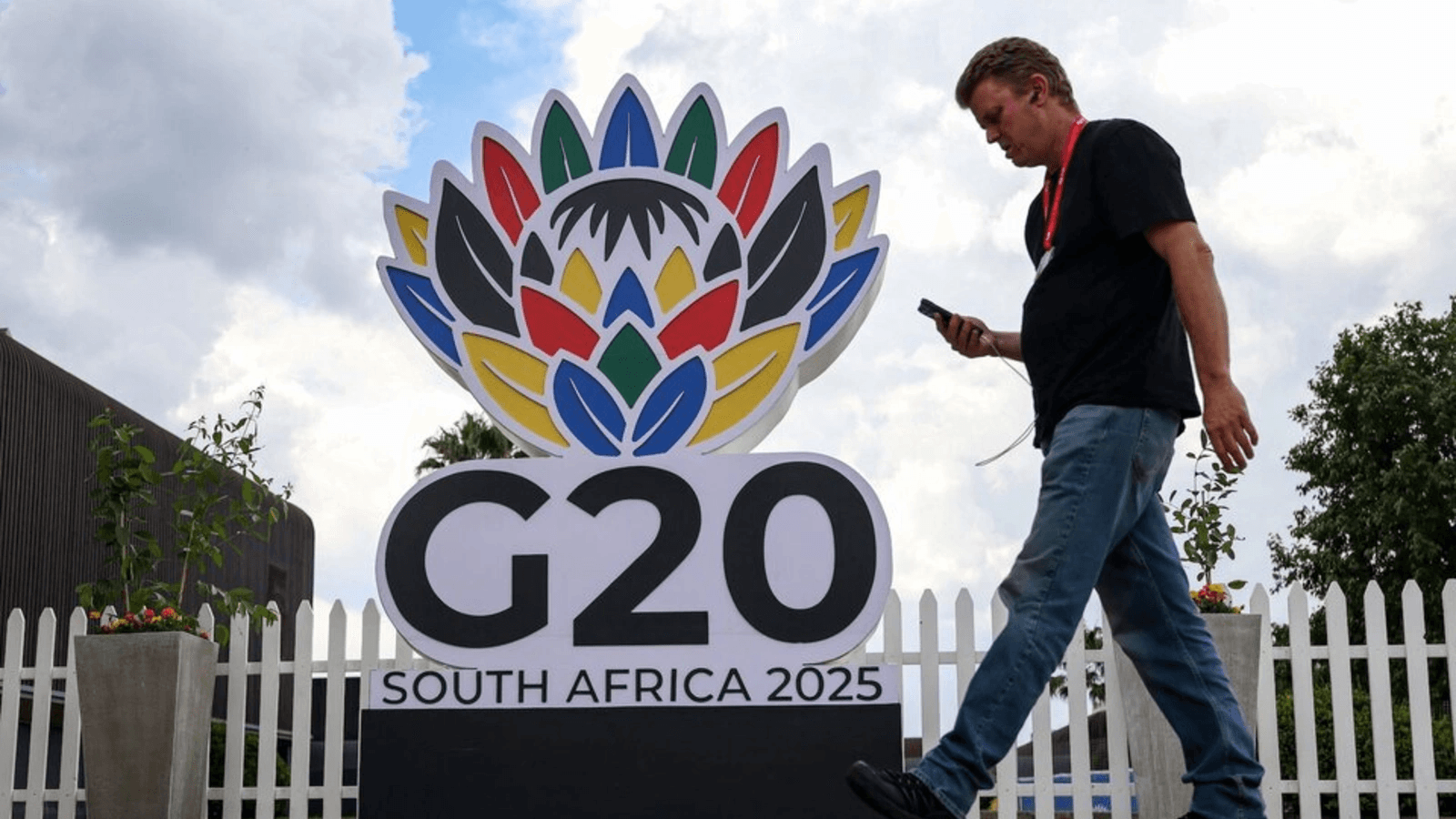
World leaders are gathering in Johannesburg, South Africa’s economic capital as of today for the annual Group of 20 (G20) leaders’ summit – the first ever to be held in an African country.
Despite US President Donald Trump’s boycott, South African leaders say the meeting will go ahead. About 42 countries and institutions including the African Union and European Union will be represented at the meeting.
Recommended News
US Delegation Praises GERD as a Landmark Achievement for Ethiopia and Africa’s Energy Future
Washington, a founding member of the group, is next in line to take over the rotating presidency from Pretoria, and South Africa’s President Cyril Ramaphosa has promised to symbolically hand over to an empty chair if necessary.
Despite the drama over the US attendance, Johannesburg has been buzzing with activity all week in preparation for the summit, as workers clean up and decorate the bustling city. Ramaphosa himself drew surprise when he donned dungarees and picked up cleaning tools.
Bright flowers and colourful G20 billboards adorn the streets through which dignitaries will pass on their way from the OR Tambo international airport into the city.
At least 3,500 extra police officials have been deployed to bolster security for the high-level guests, while the army has been placed on standby.
The G20 was founded in 1999 as an informal economic grouping of the world’s biggest economic powers.
But it was the 2008 economic crisis that propelled the G20 into prominence: In a world where major Global South economies like China and India were playing increasingly vital roles, the G7 grouping of seven wealthy nations was no longer equipped to stop the financial bloodbath that spanned continents.
Since then, G20 leaders have met at least once every year for summits.
The grouping originally comprised 19 countries (Argentina, Australia, Brazil, Canada, China, France, Germany, India, Indonesia, Italy, Japan, South Korea, Mexico, Russia, Saudi Arabia, South Africa, Turkiye, the United Kingdom, and the US), plus the European Union as the 20th entity. Since 2023, the African Union has been a member, too. Combined, they represent 85 percent of global gross domestic product (GDP) and two-thirds of the world’s population, according to the G20.
G20 country representatives meet throughout the year to discuss pressing issues. But in November, the leaders meet for the annual summit.
The leaders’ summit marks the culmination of the host country’s yearlong stewardship and usually ends with a non-binding leaders’ declaration. In Brazil last November, leaders issued a statement reaffirming their commitment to achieving the United Nations’ Sustainable Development Goals by a 2030 deadline.
South Africa has held the presidency since November 2024 and will hand over to the US on November 30, 2025. This weekend’s meeting will take place over two days from Saturday, November 22, at Johannesburg’s 150,000 square-metre Nasrec Expo Centre, the country’s largest convention centre.
Who is attending?
Forty-two countries and organisations have confirmed their attendance, according to South African officials speaking to reporters on Monday.
At least six heads of state are not attending the summit, though, apart from the US, the others are sending high-level representatives, Foreign Minister Ronald Lamola said, describing this attendance rate as a “success” for South Africa.
Some of the most notable names expected at the summit include: China’s Premier Li Qiang, French President Emmanuel Macron, India’s Prime Minister Narendra Modi, Germany’s Chancellor Friedrich Merz, UK Prime Minister Keir Starmer, Brazil’s President Luiz Inacio Lula da Silva, Turkiye’s President Recep Tayyip Erdogan, Italian Prime Minister Giorgia Meloni, Japanese Prime Minister Sanae Takaichi, Canadian Prime Minister Mark Carney and Australian Prime Minister Anthony Albanese as well as Ethiopia’s Prime Minister Abiy Ahmed.
African Union Commission chairperson Mahamoud Ali Youssouf, President of the European Council Antonio Costa, President of the European Commission Ursula von der Leyen and United Nations Secretary-General Antonio Guterres will also be present.
Who else will not attend?
Argentina’s Javier Milei, a Trump ally, will not attend the meeting either but will send Foreign Minister Pablo Quirino. Milei did not state why he withdrew.
China’s Foreign Ministry on November 14 also announced that President Xi Jinping had cancelled his attendance at the meeting, and would instead be represented by Prime Minister Li Qiang. The ministry did not state why, but South Africa and China have a thriving trade relationship. President Xi was in the country for the 2023 BRICS summit, another informal grouping of developing powers.
The Kremlin announced in October that Russia’s President Vladimir Putin would not attend the meeting and would instead send his deputy head of the presidential administration, Maxim Oreshkin. Putin is the subject of an international arrest warrant issued by the International Criminal Court (ICC) for alleged war crimes in Ukraine, and as a signatory, South Africa is legally obliged to arrest him if he sets foot in the country.
Nigeria’s President Bola Ahmed Tinubu cancelled his trip after 25 girls were kidnapped this week from their school amid a security crisis in the country.
Mexico’s President Claudia Sheinbaum will not attend due to scheduled appointments in the country, the government announced this week. Foreign Minister Juan Ramon de la Fuente usually represents her abroad.
What’s on the agenda?
South Africa, as host, will emphasise issues which affect Global South countries and is hoping to persuade leaders to collectively pledge their commitment to addressing topics from economic inequalities to improving development financing for vulnerable countries.
South Africa will also lobby countries to commit to scaling up their spending on climate-disaster resilience and disaster responses globally; increase the amount of climate finance flowing from richer to poorer nations; provide better debt restructuring and relief for poorer nations via international financial institutions and bilateral lending; and prioritise local communities and source countries amid a race among global powers for access to critical minerals, some of which are concentrated in African countries.
South Africa has not hosted an international event on this scale since the 2010 FIFA World Cup. Despite the snub from the US, this is an important moment for the country, and for Africa, Gilad Isaacs, executive director of South African think tank, the Institute for Economic Justice, told Al Jazeera, saying Pretoria has put “real issues” affecting African countries on the agenda this time.
“The US boycott will not derail the work,” Isaacs said. “The credibility of the presidency will be measured not by the presence of any one country, but by whether the agenda set in the interests of the Global South is carried through and used in other forums.”