May 29, 2026
By Maria Julius
Introduction: Beyond Simplistic Narratives
As Ethiopia heads toward its 7th General Election on June 1, 2026, international commentary has increasingly framed the process through the lens of conflict, fragmentation, repression, and democratic deficit. Numerous foreign media outlets and advocacy organizations have portrayed the election primarily as a symbolic exercise designed to legitimize the incumbent administration rather than a meaningful democratic process.
While concerns regarding security, political inclusion, and institutional maturity deserve serious examination, much of the external analysis surrounding Ethiopia’s election has often failed to appreciate the broader historical, geopolitical, and structural realities shaping the country. Ethiopia today is not merely conducting another electoral exercise. It is navigating one of the most complex state-building projects in contemporary Africa while simultaneously confronting internal insurgencies, economic restructuring, regional rivalries, and intense geopolitical competition.
The 2026 election must therefore be understood not simply as a referendum on one administration, but as part of Ethiopia’s larger struggle to preserve state continuity, maintain national cohesion, and redefine its political future after years of war, fragmentation, and institutional transition.
The central question is not whether Ethiopia’s democracy is perfect. No post-conflict democracy is. The more important question is whether Ethiopia is moving toward broader institutional consolidation under extraordinarily difficult circumstances—or whether external narratives are selectively magnifying shortcomings while overlooking significant national progress and strategic realities.
Ethiopia’s Democratic Journey Must Be Judged Historically, Not Selectively
One of the recurring weaknesses in international commentary on Ethiopia is the tendency to assess the country against idealized democratic benchmarks detached from its historical trajectory.
For decades, Ethiopia functioned under highly centralized systems—first imperial absolutism, then military dictatorship, and later the dominant-party rule of the EPRDF. Competitive multiparty politics has therefore never emerged within conditions of peace, institutional stability, and economic prosperity.
The transition initiated in 2018 under Prime Minister Abiy Ahmed represented one of the most dramatic political openings in modern Ethiopian history. Political prisoners were released, banned political organizations were invited back into the country, exiled opposition leaders returned, media restrictions were loosened, and civic space expanded significantly compared to previous eras.
These developments are often acknowledged only briefly before international narratives quickly pivot toward criticism. Yet the scale of the transformation should not be understated. Ethiopia attempted political liberalization while simultaneously managing deep ethnic tensions, historical grievances, weak institutions, economic inequality, and one of the deadliest conflicts of the 21st century.
Many of the same international actors who now criticize Ethiopia’s democratic imperfections often overlook that even established democracies historically evolved through periods of instability, civil conflict, contested elections, and institutional experimentation.
Democratization in fragile multinational states is rarely linear. Ethiopia’s political transition was never going to unfold without resistance, reversals, or contradictions.
Elections Amid Conflict: A Challenge, Not a Disqualification
A major argument advanced by critics is that ongoing insecurity in parts of Amhara, Oromia, and Tigray undermines the legitimacy of the election. While conflict unquestionably complicates electoral participation, it does not automatically invalidate the broader national democratic process.
In reality, many countries have conducted elections during periods of conflict or instability. Elections in post-conflict societies are often imperfect transitional mechanisms designed to preserve constitutional continuity while longer-term peacebuilding efforts continue.
What critics frequently fail to acknowledge is the scale of Ethiopia’s effort to maintain institutional governance despite enormous pressures.
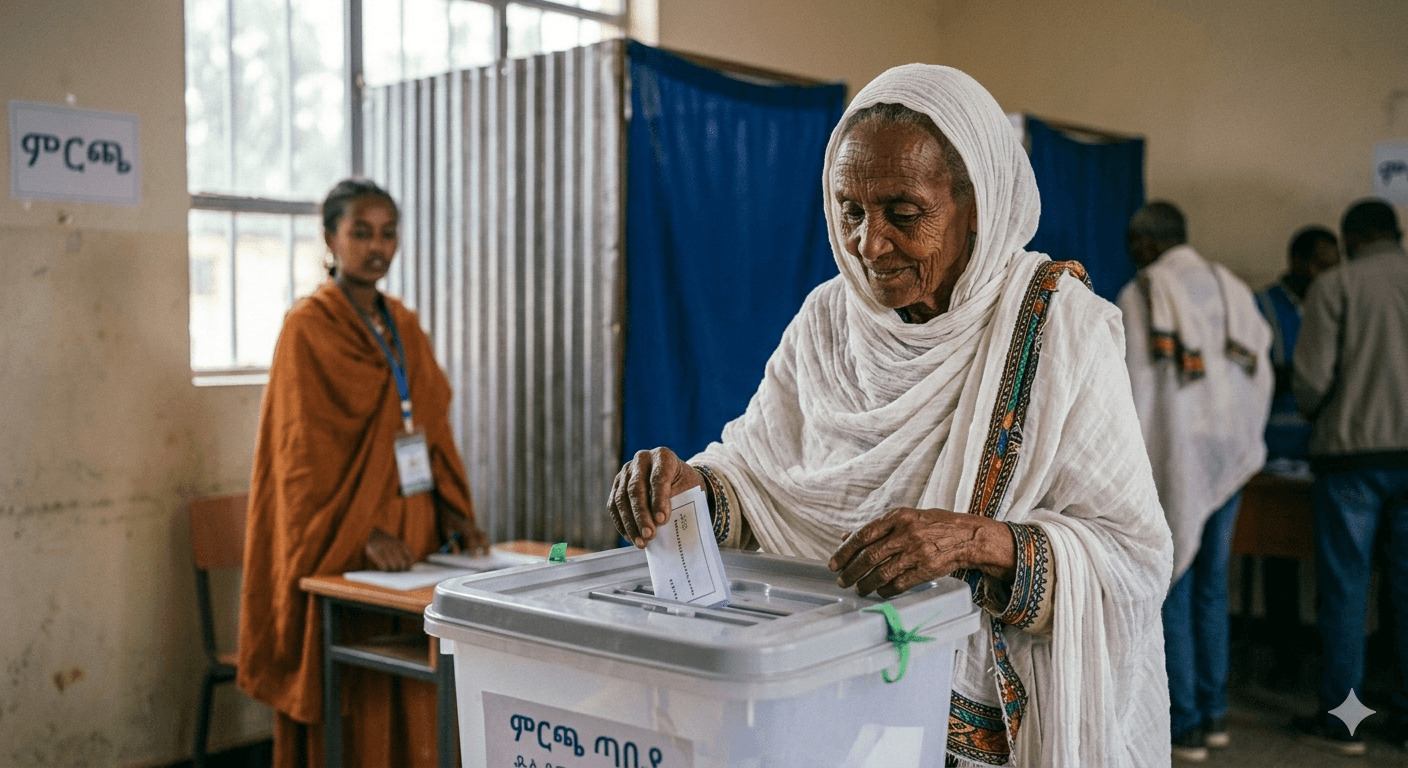
The National Election Board of Ethiopia (NEBE) has undertaken extensive voter registration initiatives, digital monitoring reforms, and logistical preparations in one of Africa’s most geographically and politically complex environments. Tens of millions of citizens have registered to vote despite ongoing security challenges.
Moreover, the Ethiopian state is confronting armed movements that are not merely political competitors but heavily militarized actors operating outside constitutional frameworks. In Amhara and Oromia particularly, armed groups have actively discouraged participation in electoral processes and, in some cases, openly threatened civilians involved in voting.
This distinction matters profoundly.
No democratic state can simultaneously be expected to preserve constitutional order while tolerating armed insurgencies seeking to replace institutional politics with military coercion.
The reality is that Ethiopia faces a dual burden:
· preserving democratic continuity;
· while simultaneously defending the integrity of the state itself.
International criticism often underestimates this dilemma.
The Tigray Question: Complexity Beyond Simplified Framing
The exclusion of Tigray from the election has become a centerpiece of external criticism. However, many international narratives present the issue in a simplified and politically selective manner.
The post-war political landscape in Tigray remains extraordinarily fragile. The federal government and regional actors continue to navigate unresolved disputes involving governance arrangements, constitutional authority, territorial administration, displaced populations, and implementation of the Pretoria Agreement.
The suspension of the Tigray Region’s participation in the elections is due to the failure of the Tigray People’s Liberation Front (TPLF) to meet legal requirements, exemplifies ongoing tensions and the difficulties in ensuring nationwide inclusivity. The Tigray regional state is administered currently under a transitional government authorized by the country’s prime minister in accordance with the November 2022 Pretoria agreement that put an end to a two-year armed conflict. However, the Tigray transitional government has faced resistance from radical elements and armed groups hell bent on subverting the new democratic dispensations.
Critics frequently frame the federal government as solely responsible for the impasse while paying insufficient attention to the role of armed and political actors within Tigray itself, including divisions inside the TPLF and unilateral political actions that have complicated normalization efforts.
The reality is that conducting elections in a post-war environment requires minimum institutional consensus and security guarantees. Ethiopia’s challenge in Tigray reflects the difficulty of rebuilding governance after a catastrophic conflict—not necessarily a deliberate attempt to permanently disenfranchise a population.
More importantly, reducing Ethiopia’s entire democratic trajectory to the Tigray issue risks ignoring the participation of tens of millions of citizens across the rest of the country.
Opposition Fragmentation Is Not Solely State Repression
Another dominant external narrative portrays opposition weakness entirely as a consequence of state repression. While concerns regarding political freedoms deserve attention, such interpretations often oversimplify Ethiopia’s political reality.
The opposition landscape in Ethiopia has long been fragmented by ideology, ethnicity, organizational weakness, leadership rivalries, and competing visions of the state itself.
Some parties advocate stronger federalism.Others seek centralization.Some prioritize ethnic nationalism.Others emphasize pan-Ethiopian nationalism.
These divisions predate the current administration.
In many cases, opposition parties have struggled not only because of government pressure but because they lack nationwide organizational structures, coherent policy alternatives, financial capacity, or broad cross-ethnic appeal.
Moreover, some external analyses appear to treat all opposition actors as inherently democratic while portraying the government as uniquely coercive. This binary framing ignores the reality that certain armed movements have also employed violence, intimidation, and anti-democratic tactics.
A balanced assessment requires acknowledging both:
· the need for broader political openness;
· and the responsibility of opposition actors to engage constructively within peaceful constitutional frameworks.
Ethiopia’s Economic Transformation Is Part of the Democratic Story
Much commentary surrounding the election focuses heavily on inflation, displacement, and economic hardship—real challenges that affect millions of Ethiopians. Yet comparatively little attention is given to the broader economic transformation underway.
Ethiopia is attempting one of Africa’s most ambitious economic modernization projects:
· liberalizing key sectors;
· expanding energy production;
· building infrastructure;
· reforming macroeconomic systems;
· digitizing financial services;
· and increasing regional trade integration.
The completion and operationalization of the Grand Ethiopian Renaissance Dam (GERD) represents not merely an infrastructure project, but a symbol of national sovereignty, self-reliance, and long-term economic transformation.
The GERD has dramatically expanded Ethiopia’s energy capacity and has the potential to reshape regional economic integration across East Africa.
Similarly, investments in transport corridors, telecommunications, industrial parks, urban development, and logistics infrastructure reflect a broader state-building strategy aimed at transforming Ethiopia into a major continental economic actor.
Critics often dismiss visible development projects as public relations exercises while underestimating their strategic significance for long-term national modernization.
For many Ethiopians, the aspiration for development, stability, and national dignity remains inseparable from the political process itself.
Ethiopia and the Horn of Africa: The Geopolitical Dimension
The 2026 election cannot be understood outside the geopolitical realities of the Horn of Africa.
Ethiopia occupies one of the world’s most strategically sensitive regions:
· bordering Sudan, Somalia, Eritrea, Djibouti, Kenya, and South Sudan;
· situated near the Red Sea corridor;
· and deeply connected to Middle Eastern security dynamics.
Regional rivalries involving Egypt, Eritrea, Gulf states, Turkey, Israel, Iran, and Sudan all intersect within Ethiopia’s political environment.
The GERD dispute with Egypt alone has transformed Ethiopia into a focal point of continental geopolitical competition.
At the same time, Ethiopia’s efforts to secure reliable maritime access through regional partnerships have generated additional tensions involving Somaliland, Somalia, Eritrea, and external powers.
In this context, internal instability inside Ethiopia carries implications far beyond domestic politics.
A fragmented or weakened Ethiopia would not simply affect Ethiopians—it would destabilize the entire Horn of Africa.
This reality partly explains why the Ethiopian state prioritizes national cohesion, territorial integrity, and institutional continuity so strongly.
External commentary often treats these concerns as merely authoritarian instincts while overlooking the genuine security calculations confronting the Ethiopian state.
Why Negative Narratives About Ethiopia Persist
An important but often ignored question is why Ethiopia consistently attracts disproportionately negative international framing compared to other states facing comparable or worse governance challenges.
Several factors contribute to this pattern.
1. Ethiopia’s Strategic Independence
Ethiopia has historically pursued an unusually independent foreign policy. Whether regarding the GERD, regional diplomacy, or security partnerships, Addis Ababa has often resisted external pressure from larger powers and international institutions.
States that pursue strategic autonomy frequently attract heightened scrutiny.
2. Ethiopia’s Symbolic Importance in Africa
As Africa’s second most populous country and headquarters of the African Union, Ethiopia carries enormous symbolic and political significance.
Its success—or failure—has continental implications.
3. Competing Geopolitical Interests
Regional powers have competing interests regarding Ethiopia’s rise:
· Egypt fears strategic disadvantage over Nile waters;
· Eritrea fears regional marginalization;
· Gulf powers compete for influence in the Red Sea corridor;
· and global powers seek alignment within shifting geopolitical blocs.
These rivalries inevitably shape international narratives surrounding Ethiopia.
4. Simplification by International Media
Complex African political realities are often reduced into simplistic binaries:
· democracy versus authoritarianism;
· government versus opposition;
· reform versus repression.
Such framing frequently ignores historical context, state fragility, security dilemmas, and competing political visions inside multiethnic societies.
Ethiopia’s Federal Challenge: The Core Structural Question
At the heart of Ethiopia’s political tensions lies the unresolved question of how to manage diversity within a modern multinational state.
The ethnic federal system established in 1991 was intended to address historical marginalization and provide self-governance for different communities. Yet it also institutionalized ethnic competition as the organizing principle of political power.
The resulting tensions are visible across multiple regions.
Prime Minister Abiy Ahmed’s administration has increasingly emphasized a broader Ethiopian national identity alongside federalism. Supporters view this as an attempt to strengthen national unity and overcome fragmentation. Critics fear centralization and erosion of regional autonomy.
This debate is not unique to Ethiopia.
Many multinational states struggle to balance:
· local autonomy;
· national cohesion;
· representation;
· and state stability.
The 2026 election therefore represents more than a contest for parliamentary seats. It reflects a deeper national debate about the future architecture of the Ethiopian state itself.
The Limits of External Prescriptions
Many international reports conclude by calling for more external pressure from Western governments and institutions.
However, externally imposed political formulas rarely succeed when they fail to align with domestic realities.
Sustainable democratic development in Ethiopia will ultimately depend on:
· internal dialogue;
· institutional strengthening;
· peacebuilding;
· economic inclusion;
· and gradual political maturation.
Foreign pressure that ignores Ethiopia’s sovereignty concerns or security realities risks deepening polarization rather than promoting democratic consolidation.
Constructive international engagement should support:
· peace implementation;
· inclusive dialogue;
· economic recovery;
· humanitarian support;
· and institutional capacity building,rather than treating Ethiopia solely as a case study in democratic failure.
Conclusion: Ethiopia’s Election as a Test of National Resilience
Ethiopia’s 2026 election is taking place under undeniably difficult conditions:
· post-war trauma;
· insurgencies;
· economic strain;
· regional tensions;
· and institutional fragility.
Yet the election also reflects a deeper national determination to preserve constitutional continuity and pursue political evolution despite immense pressure.
The country’s democratic trajectory remains incomplete and contested. Legitimate concerns regarding political openness, media freedom, and inclusion should neither be dismissed nor ignored.
At the same time, reducing Ethiopia’s political reality to narratives of repression and illegitimacy alone fails to capture the extraordinary complexity of the country’s transition.
Ethiopia today is simultaneously:
· rebuilding after devastating conflict;
· managing one of Africa’s most complex multinational political systems;
· pursuing economic transformation;
· and navigating intense geopolitical competition.
The significance of the 2026 election therefore extends beyond who wins parliamentary seats.
It represents a broader struggle over:
· whether Ethiopia can maintain national cohesion;
· whether democratic institutions can evolve amid instability;
· and whether African states can pursue modernization and sovereignty without external actors defining their political legitimacy on their behalf.
The future of Ethiopia will ultimately be determined not by simplified external narratives, but by the resilience, political wisdom, and collective aspirations of the Ethiopian people themselves.